March 1996
The Everest Season Opens
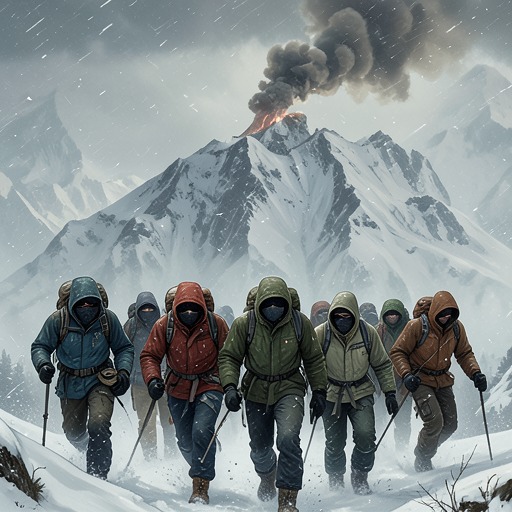
An unusually snowy winter lingered across the Himalaya as the 1996 climbing season began. Sherpas watched the comet Hyakutake cross the night sky and worried that its strange appearance foretold trouble, while delayed snowmelt threatened the supply caravans that commercial expeditions needed before the brief summit weather window closed.
At [Pangboche](entity:location-recall-location-pangboche-feaf73b4957d), Kami Noru Sherpa held a Buddhist puja with monks and fellow workers bound for the mountain. They accepted protective red amulets and prepared to leave their families for dangerous, poorly paid work on a mountain increasingly crowded with clients.
Early 1996, before the expedition
The Commercial Everest Boom
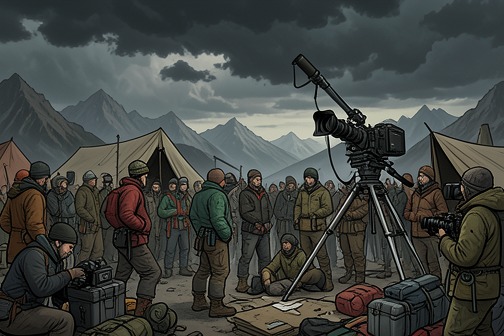
By 1996, Everest had become a commercial destination as well as a mountaineering objective. More than four hundred people would converge on Base Camp, and the expedition landscape included serious veterans, film crews, and clients whose experience varied widely. [Ed Viesturs](entity:character-recall-character-ed-viesturs-b229dfdf45c4) worried that many climbers did not belong on the mountain.
The IMAX/IWERKS expedition led by [David Breashears](entity:character-recall-character-david-breashears-953820e8343f) brought a large film budget and celebrity attention. Nearby, [Henry Todd](entity:character-recall-character-henry-todd-3bd0cc8a9fa5)’s [Himalayan Guides](entity:organization-recall-organization-himalayan-guides-dd51f820e18f) and [Rob Hall](entity:character-recall-character-rob-hall-3ec6a4a135d7)’s [Adventure Consultants](entity:organization-recall-organization-adventure-consul-1a9bf04de3f4) prepared commercial climbs. Hall’s record and glossy advertising raised the stakes for [Scott Fischer](entity:character-recall-character-scott-fischer-b97931caba5a), a gifted climber entering the Everest guiding business in direct competition with him.
Late 1995 to early 1996
Fischer Enters the Everest Market
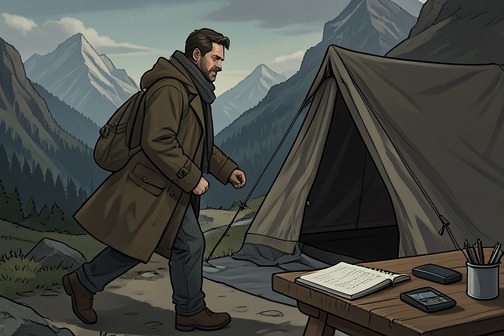
[Scott Fischer](entity:character-recall-character-scott-fischer-b97931caba5a) saw Everest as a chance to build [Mountain Madness](entity:organization-recall-organization-mountain-madness-9932bd1f4f2e) into a profitable, high-profile operation. He had climbed the mountain without bottled oxygen, but he was also carrying a demanding travel schedule, family obligations, financial pressure, and hopes of becoming more visible in the climbing world.
[Outside](entity:organization-recall-organization-outside-0570b7167308) negotiated for journalist [Jon Krakauer](entity:character-recall-character-jon-krakauer-91baedf49680) to join Fischer’s team, but ultimately bought Krakauer’s place from [Rob Hall](entity:character-recall-character-rob-hall-3ec6a4a135d7) at a lower price. Fischer was furious at the magazine’s decision. Mountain Madness then recruited [Sandy Hill Pittman](entity:character-recall-character-sandy-hill-pittman-c83ad7e43dec), an experienced climber with an [NBC](entity:organization-recall-organization-nbc-cca15f5221f8) online reporting arrangement whose summit success promised enormous publicity—and whose failure could become a public-relations disaster.
October 1995, Kathmandu
Boukreev Joins Mountain Madness
[Anatoli Boukreev](entity:character-recall-character-anatoli-boukreev-b2e12323bba4) arrived in [Kathmandu](entity:location-recall-location-6de19eff46b6) looking for work after a Kazakh expedition to [Manaslu](entity:location-recall-location-0f97e1a9af04) had been postponed. He had just made a remarkably fast, solo ascent of [Dhaulagiri](entity:location-recall-location-cd14185156dd) without supplementary oxygen, but the post-Soviet collapse had left even elite climbers struggling to finance their careers.
[Scott Fischer](entity:character-recall-character-scott-fischer-b97931caba5a) invited Boukreev to guide [Mountain Madness](entity:organization-recall-organization-mountain-madness-9932bd1f4f2e) on Everest and proposed future work on other high peaks. Boukreev asked for more money, then accepted Fischer’s offer after Fischer agreed to his price. Fischer valued him as a powerful high-altitude climber who could get people off the mountain if trouble came.
December 1995
The Manaslu Night Rescue
On a winter expedition to [Manaslu](entity:location-recall-location-0f97e1a9af04), Boukreev and the Kazakh team reached high camp in brutal cold and summited. During the descent, two climbers became stranded on a steep face. Boukreev and Shafkat Gataullin climbed back into the night to find them and tethered the exhausted men to bring them down.
Near [Camp III](entity:location-recall-location-camp-iii-b01c082d7b97), one climber slipped, dragging the other and Boukreev over an ice wall. A rope anchor stopped their fall, but Boukreev lost his gloves and briefly frostbitten hands. All three survived. The near-disaster became a grim reminder that even a rescue can turn into another emergency.
January to February 1996
The Oxygen Negotiations
Boukreev traveled to [St. Petersburg](entity:location-recall-location-9f1d225f9690) to arrange lightweight [Poisk](entity:organization-recall-organization-poisk-bcfebd13dfe8) oxygen canisters and commissioned a high-altitude tent for [Mountain Madness](entity:organization-recall-organization-mountain-madness-9932bd1f4f2e). [Henry Todd](entity:character-recall-character-henry-todd-3bd0cc8a9fa5) had already secured exclusive control of Poisk’s Everest supply, however, and the oxygen shipment was delayed at a Russian border because of another cargo item’s paperwork.
Mountain Madness considered buying from a second supplier, but Todd forced the company to accept his bundled deal for cylinders, masks, and regulators. The expedition secured its oxygen late and at high cost. The numbers on the order would later matter greatly, as the supply became a central constraint on summit day.
February 1996
Fischer Claims Lhotse
Fischer learned that Boukreev might guide a former client on [Lhotse](entity:location-recall-location-lhotse-cf3b269ee2c0) after Everest and insisted that any such work must go through [Mountain Madness](entity:organization-recall-organization-mountain-madness-9932bd1f4f2e). He offered to cover permit costs and pay an additional fee if Boukreev guided the company’s own interested clients.
Boukreev accepted. He was grateful for a foothold in commercial climbing, but the exchange also showed how expedition work blurred friendship, contracts, and personal ambition. His task was to bring professional judgment to clients whose expectations and business arrangements did not always match his own mountaineering traditions.
Late 1995 to February 1996
Fischer Builds His Team
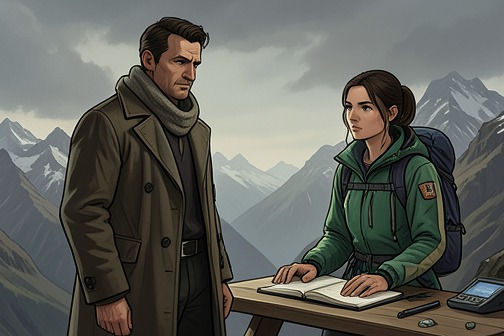
In Denmark, Fischer invited [Lene Gammelgaard](entity:character-recall-character-lene-gammelgaard-573707f01bf2) to Everest just as she had resolved to leave mountaineering and settle down. She immediately accepted the challenge of becoming the first Scandinavian woman to summit the mountain, then worked long days to find sponsors. She also saw how exhausted and often sick Fischer had become, and urged him to rest.
[Mountain Madness](entity:organization-recall-organization-mountain-madness-9932bd1f4f2e) recruited [Pete Schoening](entity:character-recall-character-pete-schoening-9a58c9c59bd8), his nephew Klev, [Martin Adams](entity:character-recall-character-martin-adams-8d39645c31a5), [Charlotte Fox](entity:character-recall-character-charlotte-fox-0ceeb644f426), [Tim Madsen](entity:character-recall-character-tim-madsen-cdf6255a3b89), and [Dale Kruse](entity:character-recall-character-dale-kruse-6885974431d9). The clients differed sharply in age, experience, and altitude tolerance. Gammelgaard doubted Kruse could cope with a high mountain, while Adams trusted Boukreev’s directness and experience enough to sign on.
March 13–25, 1996
The Team Reaches Nepal
Boukreev flew from [Almaty](entity:location-recall-location-22cde002c3c1) to [Kathmandu](entity:location-recall-location-6de19eff46b6), where he checked on the delayed oxygen and gathered climbing supplies. The expedition’s custom tent was still in [Russia](entity:location-recall-location-e36341713c23), and the oxygen had not yet reached [Nepal](entity:location-recall-location-b074390d3411). Fischer arrived on March 22 and had to confront the unresolved logistics before his clients had even arrived.
Boukreev and Ngima Sherpa flew with cargo to [Syangboche](entity:location-recall-location-9f050dfe6b6c) on March 25, then began the trek toward Base Camp. Rain, snow, and stalled yak caravans slowed everyone. Boukreev moved faster than the clients because he was already acclimatized from months at altitude and several recent 8,000-meter climbs.
March 28–30, 1996
The Clients Take a High Jump
Fischer changed the clients’ planned gradual approach and flew them to [Syangboche](entity:location-recall-location-9f050dfe6b6c) rather than [Lukla](entity:location-recall-location-lukla-67a1ab7ac7a2). The abrupt gain in elevation left many breathless and unwell; Gammelgaard was among those suffering stomach trouble. They rested in [Namche Bazaar](entity:location-recall-location-namche-bazaar-4813cd547f34) and continued toward the mountain, but the change had already challenged the acclimatization strategy designed to protect them.
Boukreev arrived at Base Camp on March 30 and began preparing the [Mountain Madness](entity:organization-recall-organization-mountain-madness-9932bd1f4f2e) site. He found that [Rob Hall](entity:character-recall-character-rob-hall-3ec6a4a135d7)’s team had marked its territory by spray-painting boulders. The overcrowding and competition were visible even before the clients reached the mountain’s first serious hazards.
March 30 to April 8, 1996
A Base Camp Built for Clients
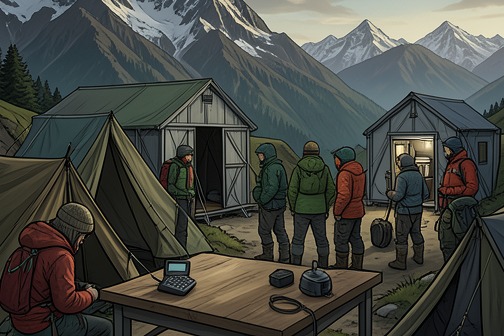
Boukreev worked with Sherpas to build tent platforms, kitchen walls, and paths while the clients remained on the trail. The [Mountain Madness](entity:organization-recall-organization-mountain-madness-9932bd1f4f2e) camp offered hot showers, communications equipment, satellite phones, computers, coffee, and rich meals—comforts that made it feel less like a remote outpost than a serviced hotel.
Fischer’s publicity agent, [Jane Bromet](entity:character-recall-character-jane-bromet-fce194b8ea84), reported for [Outside Online](entity:organization-recall-organization-outside-online-65efabc0cb53), while Pittman prepared to send daily dispatches to [NBC](entity:organization-recall-organization-nbc-cca15f5221f8). Bromet had expected access to Pittman’s satellite phone but lost it after a dispute at [Lobuche](entity:location-recall-location-lobuche-1bdb41cd09b3). Behind the camp’s polished communications, the oxygen and tent delays and Fischer’s financial pressures remained unresolved.
Early April 1996
The Missing Fourth Guide
[Mountain Madness](entity:organization-recall-organization-mountain-madness-9932bd1f4f2e) had advertised four guides, including Nazir Sabir, but Sabir withdrew shortly before the expedition. Fischer was left with himself, [Neal Beidleman](entity:character-recall-character-neal-beidleman-460debd2e561), and Boukreev to supervise a team whose clients had uneven high-altitude experience.
Boukreev identified several climbers who worried him, including [Tim Madsen](entity:character-recall-character-tim-madsen-cdf6255a3b89), [Klev Schoening](entity:character-recall-character-klev-schoening-2199a1d1fc54), Gammelgaard, and Kruse. He believed the team could succeed only if it followed a careful acclimatization plan and maintained reserves of strength. He also recognized the central tension of commercial guiding: instead of preparing climbers through years of progressive experience, guides were expected to prepare the mountain for them.
April 11, 1996
The First Icefall Crossing
The [Mountain Madness](entity:organization-recall-organization-mountain-madness-9932bd1f4f2e) clients entered the [Khumbu Icefall](entity:location-recall-location-khumbu-icefall-e13f7236549a) for the first time. Sherpas had threaded the shifting glacier with ladders and fixed ropes, but the route remained dangerous, with crevasses, collapsing seracs, and ladders spanning deep gaps. Fischer had set a four-hour crossing time as a qualification for climbing higher.
The clients made it through, but Boukreev noticed how many needed a guide’s close supervision. He worried that some expected to be managed through every danger rather than learning to act independently. Their successful crossing brought confidence, but it also sharpened his concern about whether they could care for themselves above the high camps.
April 8–18, 1996
The Acclimatization Plan
Boukreev and Fischer agreed on a staged progression through Camps I, II, and III, with nights at increasing altitude and rest periods between climbs. Boukreev wanted the clients to descend below Base Camp for a substantial recovery before the summit attempt, but Fischer did not accept that proposal.
The team made its first overnight at [Camp I](entity:location-recall-location-camp-i-aed6a9483def) and then moved to [Camp II](entity:location-recall-location-camp-ii-36e41633af22). Boukreev emphasized hydration, pacing, self-monitoring, and turning back when a climber could no longer continue. In practice, clients’ health and readiness varied widely, and the team’s shared schedule began to fray as illness, logistics, and different guiding expectations intervened.
April 19, 1996
The Body in the Snow
During an acclimatization climb above [Camp II](entity:location-recall-location-camp-ii-36e41633af22), Boukreev found the lower half of a climber’s body protruding from the snow. The discovery stopped the group and turned an abstract ambition into a physical confrontation with the mountain’s cost. Boukreev thought of the Roman custom of bringing the dead into a banquet hall so survivors could understand the price of victory.
After the clients returned to Camp II, Boukreev continued alone up the fixed ropes, checking anchors and extending the route toward 7,100 meters. The work advanced the expedition’s preparations, but the body and the delayed camps weighed on his doubts about whether commercial climbers understood the danger they had purchased the chance to face.
April 20, 1996
Fischer Rebukes Boukreev
After Boukreev returned to Base Camp, Fischer told him that he had done his work poorly because he had not helped clients set up their tents at [Camp II](entity:location-recall-location-camp-ii-36e41633af22). Boukreev explained that he had been working with the Sherpas and believed the clients were capable of managing their own tents, while he had used the time to extend the climbing route.
The exchange exposed a mismatch in expectations. Boukreev thought he had been hired for high-altitude judgment, route preparation, and rescue capacity; Fischer also expected him to attend to clients’ comfort and reassure them. Boukreev worried that the guides were falling behind in camp establishment while being asked to provide constant personal attention.
April 21, 1996
The Storm Damages Camp
A night of winds exceeding sixty miles per hour battered [Camp II](entity:location-recall-location-camp-ii-36e41633af22). Fischer and [Pete Schoening](entity:character-recall-character-pete-schoening-9a58c9c59bd8) had to collapse some tents to keep them from being destroyed. The storm made clear how quickly the mountain could erase expedition preparations and consume the time needed for acclimatization.
Boukreev and the expedition doctor, [Ingrid Hunt](entity:character-recall-character-ingrid-hunt-8cf0b682f15c), were also concerned by some clients’ poor oxygen-saturation readings and visible difficulties. The measurements were imperfect, but both saw reasons to question whether every client could safely make a summit bid.
April 22–23, 1996
Ngawang Topche Falls Ill
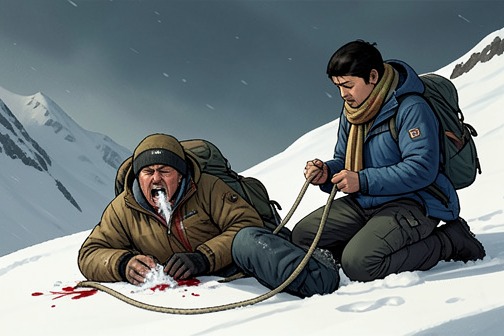
[Ngawang Topche Sherpa](entity:character-recall-character-ngawang-topche-sher-6983a4955750) became disoriented and developed symptoms of high-altitude pulmonary edema while carrying supplies toward [Camp II](entity:location-recall-location-camp-ii-36e41633af22). Fischer found him and ordered him to descend, but the Sherpa continued upward and collapsed, coughing blood and froth. Immediate descent was necessary, yet the route to safety required crossing the Icefall.
[Klev Schoening](entity:character-recall-character-klev-schoening-2199a1d1fc54) and [Tim Madsen](entity:character-recall-character-tim-madsen-cdf6255a3b89) improvised a sled and began lowering him. [Neal Beidleman](entity:character-recall-character-neal-beidleman-460debd2e561) and Sherpas took over later, guiding him through the Icefall at night. The rescue exhausted the team and left Ngawang critically ill; he was evacuated to [Kathmandu](entity:location-recall-location-6de19eff46b6), where he later died. The episode showed the human price of altitude and exposed the expedition’s weak emergency communication and staffing.
April 23–26, 1996
The Route Falls Behind
While the clients continued their acclimatization climbs, [Mountain Madness](entity:organization-recall-organization-mountain-madness-9932bd1f4f2e) remained behind in establishing [Camp III](entity:location-recall-location-camp-iii-b01c082d7b97) and fixing the route above it. Sherpas were tired and weather repeatedly disrupted work. Boukreev climbed to the proposed camp in poor visibility, but found the Sherpas descending without having prepared the site; a worsening storm confirmed their retreat was prudent.
To retain a place among the first teams attempting the summit, Boukreev agreed to help fix ropes from Camp III toward [Camp IV](entity:location-recall-location-camp-iv-5e81877b7c54). The decision cost him rest and added to the workload already separating the guides and clients across the mountain. Summit dates were beginning to circulate even though the route and camps were not fully ready.
April 26–27, 1996
Boukreev Fixes the Upper Route
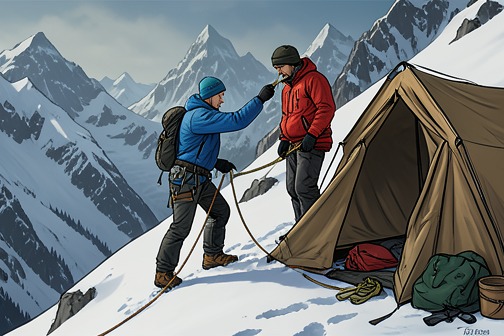
Boukreev joined [Ang Dorje Sherpa](entity:character-recall-character-ang-dorje-sherpa-1277cdbfaf5f) and other climbers in fixing rope above [Camp III](entity:location-recall-location-camp-iii-b01c082d7b97), reaching about 7,550 meters near the [Yellow Band](entity:location-recall-location-yellow-band-ab68139f4073). He stayed overnight at Camp III and continued checking old lines and anchors, then climbed toward the [South Col](entity:location-recall-location-south-col-418d68c88248) to identify a site for [Mountain Madness](entity:organization-recall-organization-mountain-madness-9932bd1f4f2e)’s highest camp.
The work made the summit route more usable, but Boukreev was losing strength through consecutive nights at altitude. When he returned to Camp III, he found several clients there, including Kruse, whose condition seemed increasingly troubling. Boukreev urged climbers to descend and rest rather than treating another night high on the mountain as progress in itself.
April 28–29, 1996
Kruse Is Brought Down
At [Camp III](entity:location-recall-location-camp-iii-b01c082d7b97), Boukreev saw that Kruse was apathetic, unsteady, and struggling to stand. He feared that Kruse might fall on the steep ropes and would be impossible to manage alone. Fischer arrived with Beidleman, and Fischer and Boukreev secured Kruse between them for the descent.
By lower elevations Kruse recovered enough to move more normally, but the incident reinforced Boukreev’s concern that he was at risk of severe altitude illness. Boukreev continued down with Kruse and Gammelgaard, then rested at Base Camp. Fischer still hoped to keep clients under observation rather than ruling them out before the final push.
May 1–4, 1996
Gammelgaard Accepts Oxygen
Fischer told Gammelgaard that the team would make its final push with oxygen, ending her hope of attempting Everest without it. She was furious that the expedition’s delays had left too little time for her to acclimatize for an oxygen-free ascent. Boukreev privately agreed that the attempt would be dangerous and persuaded her to climb with oxygen, offering to help her try without it another time.
After returning from a restorative descent to [Deboche](entity:location-recall-location-deboche-a3e025c2d990), Boukreev felt stronger, while the clients’ readiness remained uncertain. Pittman had also descended to [Pheriche](entity:location-recall-location-pheriche-8de45599a6cf) to see friends just before the summit push, a quick trip Boukreev believed cost her valuable energy. The team was to start its final ascent on May 6, despite unresolved concerns about the weather, health, and oxygen supply.
May 6, 1996
Kruse Turns Back Again
As the final push began, [Martin Adams](entity:character-recall-character-martin-adams-8d39645c31a5) found Kruse feeling too unwell to continue and resting at [Camp I](entity:location-recall-location-camp-i-aed6a9483def). Adams brought the concern to Fischer and Beidleman at [Camp II](entity:location-recall-location-camp-ii-36e41633af22). Fischer and Beidleman descended to tell Kruse he had to go down, and Fischer escorted his old friend to Base Camp himself.
The episode consumed more of Fischer’s energy and left him repeatedly traveling between camps. Kruse’s climb was over, but other clients with questionable acclimatization remained in the attempt. Boukreev reached Camp II later and continued to worry about whether the remaining climbers were ready for a summit bid.
May 7–8, 1996
Fischer Pushes Toward Camp III
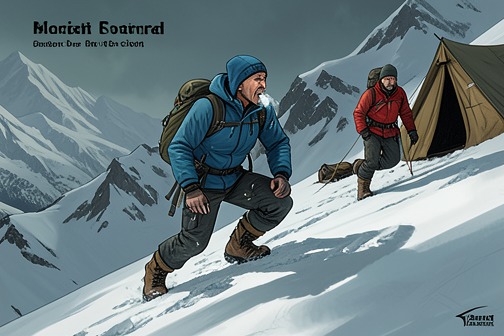
Fischer continued climbing with the team while looking increasingly tired. [Henry Todd](entity:character-recall-character-henry-todd-3bd0cc8a9fa5) encountered him in the Icefall and noticed that Fischer, normally much faster, was moving slowly and coughing seriously. Fischer said he had escorted Kruse down because his friend had been in tears and he could not send someone else in his place.
Boukreev and Fischer discussed the clients, the dwindling oxygen, and the uncertain weather as they climbed toward [Camp III](entity:location-recall-location-camp-iii-b01c082d7b97). They also passed members of [Rob Hall](entity:character-recall-character-rob-hall-3ec6a4a135d7)’s expedition, whose slower pace reinforced Boukreev’s concern about combining the teams for summit day. The IMAX team, led by [David Breashears](entity:character-recall-character-david-breashears-953820e8343f) and [Ed Viesturs](entity:character-recall-character-ed-viesturs-b229dfdf45c4), chose to retreat and wait for a better weather window.
May 9, 1996, afternoon and evening
The Summit Camp Storm
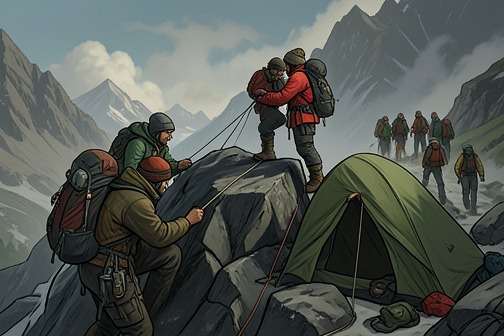
The teams climbed from [Camp III](entity:location-recall-location-camp-iii-b01c082d7b97) toward [Camp IV](entity:location-recall-location-camp-iv-5e81877b7c54) as high winds battered the exposed [South Col](entity:location-recall-location-south-col-418d68c88248). Boukreev arrived first and helped Sherpas secure the tents, deciding to use two rather than three so the climbers could share warmth and retain a spare shelter. He warned Fischer that the weather looked poor and suggested descending, but Fischer chose to wait and see whether the storm would clear.
In the tents, climbers from both [Mountain Madness](entity:organization-recall-organization-mountain-madness-9932bd1f4f2e) and [Adventure Consultants](entity:organization-recall-organization-adventure-consul-1a9bf04de3f4) questioned whether a summit attempt was wise. The wind later died, the sky cleared, and the teams prepared to leave around midnight. The decision to proceed came without a firm turnaround rule for Mountain Madness, despite the lateness and the unstable conditions.
May 9–10, 1996, before midnight
Oxygen Leaves Little Margin
[Mountain Madness](entity:organization-recall-organization-mountain-madness-9932bd1f4f2e) had sixty-two canisters at [Camp IV](entity:location-recall-location-camp-iv-5e81877b7c54), but only fifty-three lightweight [Poisk](entity:organization-recall-organization-poisk-bcfebd13dfe8) bottles were set aside for the climb. Clients and guides carried two each, while Boukreev carried one emergency bottle and gave it to Beidleman when he needed oxygen for rope work. Sherpas carried additional bottles, including caches intended for the [South Summit](entity:location-recall-location-south-summit-bad15315e640).
The plan assumed each client’s three bottles would last long enough for a summit and return if used at the recommended flow rate. It left little reserve for delays, higher flow, or a second attempt. The expedition was effectively committed to one summit day, making every bottleneck and lost minute more consequential.
May 10, 1996, around midnight
The Summit Bid Begins
The climbers left [Camp IV](entity:location-recall-location-camp-iv-5e81877b7c54) beneath a clear sky, following the line of headlamps from [Rob Hall](entity:character-recall-character-rob-hall-3ec6a4a135d7)’s team. Pittman departed first behind Lopsang, attached to a short towline. Other clients followed, including Fox, who began her birthday on the ascent. Boukreev climbed with Adams and carried oxygen as a contingency, while Fischer followed at the rear.
The teams became intermingled with one another and with climbers from the Taiwanese expedition. The route was slow and crowded, and the Sherpas had not fixed the upper ropes in advance as many clients believed they would. The summit attempt was already losing time before the climbers reached the most exposed terrain.
May 10, 1996, early morning
The Rope Bottleneck
Climbers from the combined teams crowded at the [Balcony](entity:location-recall-location-balcony-7a99f7a5edac) and higher on the ridge. Hall had required his clients to remain within roughly one hundred meters of one another, and the slowest climbers constrained the pace. The planned ropes above were missing, forcing Beidleman and Ang Dorje to move ahead and fix sections while exhausted clients waited.
The delay pushed climbers deeper into the [Death Zone](entity:expression-recall-expression-death-zone-0ab0701063f3) and consumed oxygen that had been calculated for a much smoother ascent. Several climbers began to consider turning around, but no shared, clearly communicated cutoff was operating across the teams.
May 10, 1996, around 11:40 a.m.
Kasischke Turns Back
Near the [South Summit](entity:location-recall-location-south-summit-bad15315e640), [Lou Kasischke](entity:character-recall-character-lou-kasischke-01ed8c706753) recognized that his fingers were frostbitten, his water was frozen, and the weather was worsening. A Sherpa told him the summit was still about two hours away. Kasischke understood that reaching the top was possible, but doubted he could descend alive or without losing fingers and toes.
He turned around, as did Stuart Hutchison and John Taske. When Kasischke met Fischer, Fischer approved the decision. Their retreat showed that an individual could still make a clear judgment amid the pressure to summit, but the rest of the expedition remained caught in delays and uncertain leadership.
May 10, 1996, late morning to early afternoon
Boukreev and Beidleman Fix Ropes
At the [South Summit](entity:location-recall-location-south-summit-bad15315e640), Beidleman and Adams waited as the climbers behind them jammed on the ropes. Beidleman had little oxygen left, and Boukreev had already given him his reserve canister. Seeing that the route remained unfixed, Boukreev and Beidleman moved ahead to secure the line toward the summit.
They worked through exposed terrain and the [Hillary Step](entity:location-recall-location-hillary-step-e65028e28f55), while Krakauer and Harris also passed through without completing the missing rope section. Beidleman eventually ran out of usable anchors and discarded the end of a rope rather than leave a misleading, unsecured line. Their work made the summit accessible, but cost time that the climbers could not recover.
May 10, 1996, 1:07 p.m.
Boukreev Reaches the Summit
Boukreev reached the summit first among the [Mountain Madness](entity:organization-recall-organization-mountain-madness-9932bd1f4f2e) group, relieved rather than celebratory. He stayed to wait for other climbers, but only Adams, Beidleman, and [Klev Schoening](entity:character-recall-character-klev-schoening-2199a1d1fc54) arrived promptly. With no radio and concern about the late hour, he eventually began descending.
Adams also left quickly, aware that his oxygen supply was limited. More climbers continued upward even after 2 p.m., a fact that worried observers in [Camp II](entity:location-recall-location-camp-ii-36e41633af22), including Viesturs, who could see the growing danger of depleted oxygen, fading daylight, and worsening weather.
May 10, 1996, 2:00–3:10 p.m.
The Late Summit Arrivals
More [Mountain Madness](entity:organization-recall-organization-mountain-madness-9932bd1f4f2e) clients reached the summit between roughly 2:15 and 2:30. Beidleman and the clients remained there for celebrations and photographs, even as oxygen supplies dwindled. At 3:10, Beidleman finally began leading the descent with Fox, Madsen, Pittman, and Gammelgaard.
Fischer was still ascending. Hall’s client [Doug Hansen](entity:character-recall-character-doug-hansen-2801a9fb23b0) also continued toward the summit late in the day, with Hall accompanying him. The delay on the summit and the prolonged ascent left climbers dangerously short on time and oxygen before the storm struck.
May 10, 1996, around 2:30 p.m.
Boukreev Descends Ahead
Above the [Hillary Step](entity:location-recall-location-hillary-step-e65028e28f55), Boukreev spoke with Fischer, who said he was tired but did not appear to be in obvious distress. Boukreev was concerned that clients might run out of oxygen on the descent. He proposed going quickly to [Camp IV](entity:location-recall-location-camp-iv-5e81877b7c54) to prepare hot drinks and be ready to assist, and Fischer agreed.
Boukreev left ahead of the clients and reached Camp IV before the worst of the storm. Later, his decision became the center of a dispute about guiding responsibility and oxygen use. In the moment, he believed his rapid descent would give the team a rested rescuer below, where he could respond if climbers were delayed or depleted.
May 10, 1996, afternoon
Fischer and Lopsang Fall Behind
Fischer reached the summit late and began descending in failing condition. Lopsang had waited near the summit to ensure that Hall and Hansen were safely up and down, then caught up with Fischer. The effort had left Lopsang sick and exhausted, and Fischer was also weakening.
As the storm gathered, Fischer’s oxygen supply and ability to move became uncertain. Lopsang tried to guide him down, but Fischer veered from the route in a glissade and could not continue. The two men became separated from the clients and the established descent, a development that would prove fatal for Fischer.
May 10, 1996, late afternoon
The Descent Breaks Apart
On the descent, Krakauer ran out of oxygen near the [Hillary Step](entity:location-recall-location-hillary-step-e65028e28f55) and was helped by [Mike Groom](entity:character-recall-character-mike-groom-dd08dec848c9), who gave him a canister. Further down, Adams became disoriented after exhausting his oxygen and fell into crevasses, then encountered Krakauer near [Camp IV](entity:location-recall-location-camp-iv-5e81877b7c54) without either recognizing the other.
Beidleman’s group found [Yasuko Namba](entity:character-recall-character-yasuko-namba-120ba62e32f6) nearly immobile on the fixed ropes. He and other climbers struggled to get her down, and the group became scattered. At the bottom of the fixed lines, the storm erased the camp’s lights and the climbers’ sense of direction. Their efforts to stay together gradually turned into a desperate search for shelter and a way back.
May 10–11, 1996, evening and night
The South Col Dogpile
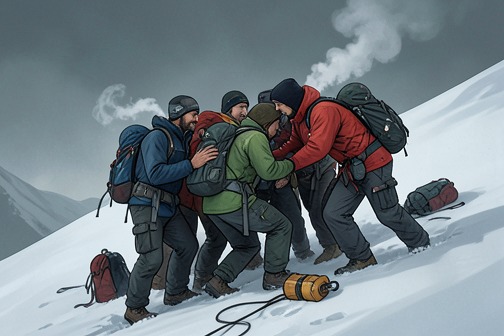
Beidleman’s group, including Namba, [Beck Weathers](entity:character-recall-character-beck-weathers-c7f264efd8df), and the [Mountain Madness](entity:organization-recall-organization-mountain-madness-9932bd1f4f2e) clients, wandered across the [South Col](entity:location-recall-location-south-col-418d68c88248) in the whiteout. With no reliable landmarks, dwindling oxygen, and hurricane-force gusts, they lost their route and eventually huddled together in a dogpile to conserve warmth and keep one another conscious.
[Klev Schoening](entity:character-recall-character-klev-schoening-2199a1d1fc54) helped maintain order and later recognized a direction toward camp during a brief improvement in visibility. The group divided: some climbers managed to move toward [Camp IV](entity:location-recall-location-camp-iv-5e81877b7c54), while Fox, Pittman, Namba, and others remained unable to walk. The storm left them only a short distance from camp, but in conditions where that distance became a life-or-death barrier.
May 10, 1996, early evening
Boukreev’s First Search
Boukreev reached [Camp IV](entity:location-recall-location-camp-iv-5e81877b7c54), warmed himself, and waited for the descending climbers. When none arrived and reports were confused, he put on crampons and carried oxygen to search above camp. The storm soon engulfed the [South Col](entity:location-recall-location-south-col-418d68c88248), obscuring the fixed ropes and freezing his glasses until he could barely see.
He searched by the lights being flashed from camp, then turned back when he feared he would fall from the mountain and become another casualty. Exhausted and nearly powerless, he returned to his tent. The attempt had found no one, and the camp still had no clear picture of where the missing climbers were.
May 10, 1996, night
The First Climbers Reach Camp
Gammelgaard and Schoening eventually found Boukreev’s light and reached [Camp IV](entity:location-recall-location-camp-iv-5e81877b7c54), followed by other exhausted climbers. Boukreev removed crampons, gave oxygen and tea, and helped them into tents. Beidleman arrived barely able to speak and collapsed inside his tent.
Boukreev learned that several climbers remained outside, including Fox, Pittman, and Madsen, while Lopsang was somewhere higher with Fischer. He attempted to recruit help from the [Mountain Madness](entity:organization-recall-organization-mountain-madness-9932bd1f4f2e) Sherpas and nearby expeditions, but the climbers and Sherpas were depleted, afraid, or unavailable. The camp’s radios and communication chain failed to provide a dependable account of the emergency.
May 11, 1996, after 2 a.m.
Boukreev Finds the Dogpile
After another attempt across the [South Col](entity:location-recall-location-south-col-418d68c88248), Boukreev found Pittman, Fox, and Madsen huddled near the [Kangshung Face](entity:location-recall-location-kangshung-face-130f966c961b), with Namba lying nearby. He had only one oxygen bottle and a thermos of tea. He gave the climbers warm drink, fitted oxygen to Pittman, and tried to bring Fox back to camp.
Fox could barely walk, so Boukreev supported her step by step through the storm and across the Col. He delivered her to Beidleman’s tent and returned to search again. Alone and without enough oxygen or strength to carry everyone, he made repeated trips, choosing to focus on those he could still move rather than risk collapsing before reaching any of them.
May 11, 1996, before dawn
The Final Rescue Crossing
Boukreev returned to the stranded group with another oxygen bottle and tea. Pittman was more responsive after oxygen and dexamethasone, and Madsen could still move under his own power. Boukreev supported Pittman across the [South Col](entity:location-recall-location-south-col-418d68c88248) and got both of them into camp as the storm began to lift.
He had no strength left to carry Namba or return for Weathers, who had wandered away from the group. Boukreev urged that Sherpas be sent to help Fischer, but could not persuade anyone to go immediately. The three [Mountain Madness](entity:organization-recall-organization-mountain-madness-9932bd1f4f2e) clients he reached survived; Namba remained outside, and Fischer was still missing above camp.
May 11, 1996, morning to afternoon
The Sherpas Search for Fischer
The remaining [Mountain Madness](entity:organization-recall-organization-mountain-madness-9932bd1f4f2e) clients began descending with Beidleman, receiving oxygen support from the IMAX team. Boukreev stayed at [Camp IV](entity:location-recall-location-camp-iv-5e81877b7c54) while Sherpas went up toward Fischer and Taiwanese climber [Makalu Gau](entity:character-recall-character-makalu-gau-ebe3c6158584). They returned with Gau alive, but Fischer remained on the mountain.
[Rob Hall](entity:character-recall-character-rob-hall-3ec6a4a135d7)’s own expedition was in crisis. Hall, Hansen, and Harris were missing or stranded, while Namba and Weathers had been found alive but gravely compromised. Hall’s final radio conversation with his wife ended at 6:20 p.m. and became the last anyone heard from him.
May 11, 1996, afternoon and evening
Boukreev’s Last Climb for Fischer
Reports from the Sherpas said Fischer was still breathing but unable to move or swallow. Boukreev asked [Ingrid Hunt](entity:character-recall-character-ingrid-hunt-8cf0b682f15c) for medical advice, secured oxygen and tea, and set out alone despite warnings that another storm was coming. He had seen Weathers survive a night in the open and hoped Fischer might also be revived.
Boukreev found Fischer near 8,350 meters at dusk. Fischer’s suit was open, one hand bare, and Boukreev could find no signs of life. Unable to move him or remain in the storm, he covered the body with Fischer’s pack and oxygen bottles and descended through darkness and poor visibility. He returned to camp exhausted and emotionally shattered.
May 12–20, 1996
The Survivors Descend
With the oxygen exhausted, the surviving [Mountain Madness](entity:organization-recall-organization-mountain-madness-9932bd1f4f2e) clients descended. Weathers and Gau were evacuated by helicopter after other climbers and expeditions helped bring them to a lower camp. Hall’s surviving team also left the mountain, abandoning hope for Hall, Hansen, and Harris.
Boukreev descended after gathering what he could of the expedition’s equipment. Though the survivors had frostbite and deep psychological wounds, most escaped without amputations. The physical survival of the Mountain Madness clients did not settle the questions surrounding the tragedy; instead, the choices made during the ascent and rescue became subjects of intense scrutiny.
May 16–17, 1996
A Solo Ascent of Lhotse
While the [Mountain Madness](entity:organization-recall-organization-mountain-madness-9932bd1f4f2e) clients began descending from Base Camp, Boukreev climbed [Lhotse](entity:location-recall-location-lhotse-cf3b269ee2c0) alone, summiting on May 17. He had wanted to return to the mountains after Fischer’s death and after failing to rescue Namba.
From the summit he looked across to Everest and traced the route down to the place where Fischer had died. The climb brought no resolution to the loss; it placed Boukreev’s grief back inside the landscape where it began.
Late May to June 1996
The Media Pursues the Survivors
The survivors tried to avoid reporters, but the disaster drew extraordinary public attention. Boukreev arrived in [Santa Fe](entity:location-recall-location-santa-fe-ef80121842d3) exhausted and troubled by recurring dreams of lost climbers he could not reach. Journalists called with complex questions that his limited English made difficult to answer precisely.
He tried to provide an interview through an interpreter, but the translated transcript distorted his meaning. Boukreev wanted the story told clearly, yet the language barrier and the media’s appetite for brief explanations left him frustrated and unable to explain the full complexity of the climb.
July–September 1996
Krakauer’s First Accusation
[Jon Krakauer](entity:character-recall-character-jon-krakauer-91baedf49680)’s [Outside](entity:organization-recall-organization-outside-0570b7167308) article portrayed Boukreev’s early descent as questionable conduct by a guide. It suggested that he went down because he was not using oxygen and was lightly dressed, and did not include Boukreev’s account that Fischer had approved the descent so he could prepare for a rescue.
Boukreev wrote to the magazine with a detailed explanation of his experience, clothing, oxygen strategy, and conversation with Fischer. Outside offered to cut his response to a few hundred words, but he refused, arguing that the circumstances could not be reduced to sound bites. The disagreement became the beginning of a public controversy over what happened on the mountain.
January 1997 onward
The Climb Takes Shape
Boukreev and [G. Weston DeWalt](entity:character-recall-character-g-weston-dewalt-ec84978d2a9f) agreed to collaborate on a book that would present Boukreev’s experience without claiming a complete explanation of every death. DeWalt traveled to interview climbers and relatives, while Boukreev supplied journals, letters, expedition logs, and memories.
Their work drew on a recorded [Mountain Madness](entity:organization-recall-organization-mountain-madness-9932bd1f4f2e) debriefing made five days after the tragedy. The participants’ recollections offered a crucial, though sometimes contradictory, record of summit day. Boukreev wanted the book to contribute facts and lessons rather than assign blame, even as public accounts increasingly cast him as a villain or a hero.
July–August 1996
Boukreev Challenges the Article
Boukreev’s letter to [Outside](entity:organization-recall-organization-outside-0570b7167308) laid out his account: Fischer had authorized him to descend, and the purpose was to be ready with oxygen and hot drinks if climbers needed help. He argued that his oxygen-free ascent reflected years of experience and that he was adequately dressed for the conditions.
Outside declined to publish the full response, offering only a sharply shortened version. Boukreev rejected the offer, saying the details mattered. He believed the article had omitted information that would have allowed readers to judge his conduct fairly.
October 1997
The Climb Meets Its Critics
The Climb was published with Boukreev’s account of the expedition and its aftermath. It emphasized his rescue efforts and his experience at altitude, while also recording his doubts about the clients, the guiding arrangement, and the commercial pressures surrounding the climb.
Krakauer and others challenged the book’s errors, interviews, and interpretations. DeWalt defended the work and maintained that it was a personal account rather than a definitive catastrophe analysis. The dispute intensified over whether Boukreev’s early descent had been authorized and whether his role had been represented honestly.
December 6, 1997
The American Alpine Club Honors Boukreev
The [American Alpine Club](entity:organization-recall-organization-american-alpine-e8b9f2ae6034) awarded Boukreev its David A. Sowles Memorial Award for extraordinary, selfless efforts to save climbers on Everest and for his attempt to reach Fischer. The award committee recognized the risk he had taken in the storm and the lives he had helped save.
Boukreev, already back in [Nepal](entity:location-recall-location-b074390d3411), sent a modest note thanking the club for trying to understand a man from another culture. The honor offered recognition from experienced mountaineers, but it did not end the public controversy or the argument over how his actions should be judged.
Late 1996 to spring 1997
Return to Everest with Indonesia
Boukreev returned to [Nepal](entity:location-recall-location-b074390d3411) and agreed to advise an Indonesian team preparing for Everest. He warned organizer [Prabowo Subianto](entity:character-recall-character-prabowo-subianto-867c6b75f6a6) that the climbers’ inexperience meant low odds of success and a serious risk of losing someone. He insisted on control over summit-day decisions and built a training and rescue structure around experienced Russian advisers.
The team trained on Paldor and [Island Peak](entity:location-recall-location-island-peak-410f59dbc7a2), selecting a smaller group for the climb. Boukreev emphasized communications, weather reports, gradual acclimatization, and a rescue reserve. The preparation was still imperfect, especially because the Sherpa team lacked depth and some planned supplies were not secured, but he sought to avoid the organizational failures that had haunted 1996.
April 22–27, 1997
The Indonesian Summit Push
The Indonesian team moved directly to [Camp II](entity:location-recall-location-camp-ii-36e41633af22) and climbed progressively higher, with Boukreev, Bashkirov, and Vinogradski assessing the climbers’ health and discipline. Several weaker members were removed from the summit group, while the remaining climbers rested at [Deboche](entity:location-recall-location-deboche-a3e025c2d990) before returning to the mountain.
Despite plans for an emergency Camp V, inadequate Sherpa support and missing equipment left the guides concerned. On summit day, the team struggled through deep snow, had to fix rope with limited supplies, and arrived late near the summit. Boukreev and the Russian advisers debated turning climbers back as their coordination and strength deteriorated.
April 27, 1997, afternoon
One Indonesian Reaches the Summit
At the top of the [Hillary Step](entity:location-recall-location-hillary-step-e65028e28f55), Boukreev warned the exhausted climbers that continuing could compromise their descent. Some refused to turn back. The summit group moved forward, and Asmujiono reached the top, while another climber collapsed short of the summit and had to be persuaded to descend.
The team spent only a brief time on the summit and then hurried down. Darkness caught them before they reached the [South Col](entity:location-recall-location-south-col-418d68c88248), forcing six climbers into a damaged emergency tent at Camp V. They rationed two oxygen bottles and hot water through a long night, relying on coordinated care rather than celebration.
April 28, 1997
Boukreev Buries Fischer and Namba
After the Indonesian climbers descended safely, Boukreev returned to the places where Fischer and Namba had died. He covered Fischer’s body with snow and stones and marked the site with an ice ax. The memorial flag from Fischer’s wife and friends was left at the summit.
At the Kangshung side of the [South Col](entity:location-recall-location-south-col-418d68c88248), Boukreev found Namba’s body partly covered by snow and ice. He gathered personal belongings for her family and covered her with stones, placing ice axes as markers. These small acts could not undo his inability to save them, but they were his way of offering respect and accepting the continuing weight of their deaths.
May 1997
Namba’s Husband Hears the Story
On the trail near [Gorak Shep](entity:location-recall-location-gorak-shep-86b95bd0dff1), Boukreev encountered [Kenichi Namba](entity:character-recall-character-kenichi-namba-837179719daf), who had come to [Nepal](entity:location-recall-location-b074390d3411) hoping to recover his wife’s body. With Muneo Nukita translating, Boukreev explained what had happened and apologized for not having been able to do more.
Kenichi Namba told him he blamed no one. He thanked Boukreev for the help he had given other climbers and for covering his wife’s body. Their conversation brought a measure of human understanding to Boukreev’s persistent guilt, though it could not erase the memory of leaving Namba on the mountain.
May 26, 1997
Bashkirov Dies on Lhotse
Boukreev and [Simone Moro](entity:character-recall-character-simone-moro-c5a6aa40cd11) attempted a [Lhotse](entity:location-recall-location-lhotse-cf3b269ee2c0)–Everest traverse with a Russian team. After summiting Lhotse, [Vladimir Bashkirov](entity:character-recall-character-vladimir-bashkirov-c93923bb6e04) collapsed from altitude illness. Boukreev called for oxygen to be brought up, but the rescuers arrived too late.
Bashkirov’s death devastated Boukreev and ended the traverse. It repeated the brutal pattern that had followed him through the Himalaya: experience and effort could not always overcome altitude, weather, and the limits of rescue.
Late 1997 to 1998
The Controversy Deepens
After Into Thin Air appeared, DeWalt argued that Krakauer had omitted Boukreev’s explanation of Fischer’s approval and had misrepresented the evidence. The two authors exchanged accusations about interviews, the debriefing tape, fact-checking, and the timing of [Jane Bromet](entity:character-recall-character-jane-bromet-fce194b8ea84)’s account of Fischer’s rescue plan.
DeWalt defended his book and highlighted testimony from Beidleman and Bromet, while Krakauer questioned the reliability of Boukreev’s recollections and the book’s reporting. The dispute became its own media story, often displacing the climbers who had died and the practical lessons about commercial guiding, oxygen, communication, and turnaround decisions.
December 1–25, 1997
Boukreev Returns to Annapurna
Boukreev joined [Simone Moro](entity:character-recall-character-simone-moro-c5a6aa40cd11) and cinematographer [Dimitri Sobolev](entity:character-recall-character-dimitri-sobolev-59d0091ceafc) for a winter attempt on [Annapurna I](entity:location-recall-location-annapurna-i-07f68def9532). They worked for weeks through deep snow to establish a camp and fix the route toward a ridge, carefully trying to limit exposure to avalanches.
On Christmas Day, a cornice released a house-sized block of ice above the climbers. Moro heard the avalanche and shouted Boukreev’s name. Boukreev and Sobolev were swept away; Moro survived the avalanche and struggled back toward help, but neither of his companions returned.
January 3, 1998
The Search Ends
A Kazakh search team reached the avalanche site at [Camp I](entity:location-recall-location-camp-i-aed6a9483def) and found the tent as Moro had left it, but there was no sign of Boukreev or Sobolev. Their disappearance ended hope that they had survived in shelter nearby.
DeWalt rejected premature attempts to reduce Boukreev’s life to the villain of another writer’s account. He remembered him as a courageous mountaineer and a difficult, devoted friend. The book closes with the loss of Boukreev and Sobolev, carrying forward the memorial plea not to forget climbers who never return from the summits.